
This is the first in what will probably be a series of articles in which I will examine the ongoing problems with TSMC’s Fab 21 in Arizona, and try to situate that within the larger context of international trade and politics.
Before reading this piece, I highly suggest checking out this excellent article by Viola Zhou in Rest of World. I’m going to try to keep this article succinct, so if you’re not up to speed on the TSMC/AZ situation you might be missing important context.
I should also note that I am not a neutral observer. My wife worked at TSMC until just recently, and I still have many close friends employed at Fab 21. I even lived in Taiwan for a time with the American hires. All of this undoubtedly biases my view.
There’s an epic culture war going on in the sandy plains of Arizona. However, this isn’t another battle over abortion, DEI, or the other current flashpoints in American politics. No, this battle is being waged over an entirely different issue: working conditions at the worlds top semiconductor company.
For years now Taiwan Semiconductor Manufacturing Company (TSMC) has been building a massive semiconductor factory out in North Phoenix. This facility, and the two more that will follow it, represent the largest foreign direct investment in a greenfield project in US history, at over $65 Billion. More importantly, they will produce leading edge chips that even Intel and Samsung can’t currently make. To say it’s a big deal would be an understatement. Unfortunately, as article after article has detailed, there have been intense conflicts between the American workers and Taiwanese management. There’s been a lot of speculation about the source of this conflict, and while there are many factors, a big one is that TSMC is not used to operating without substantial public support.
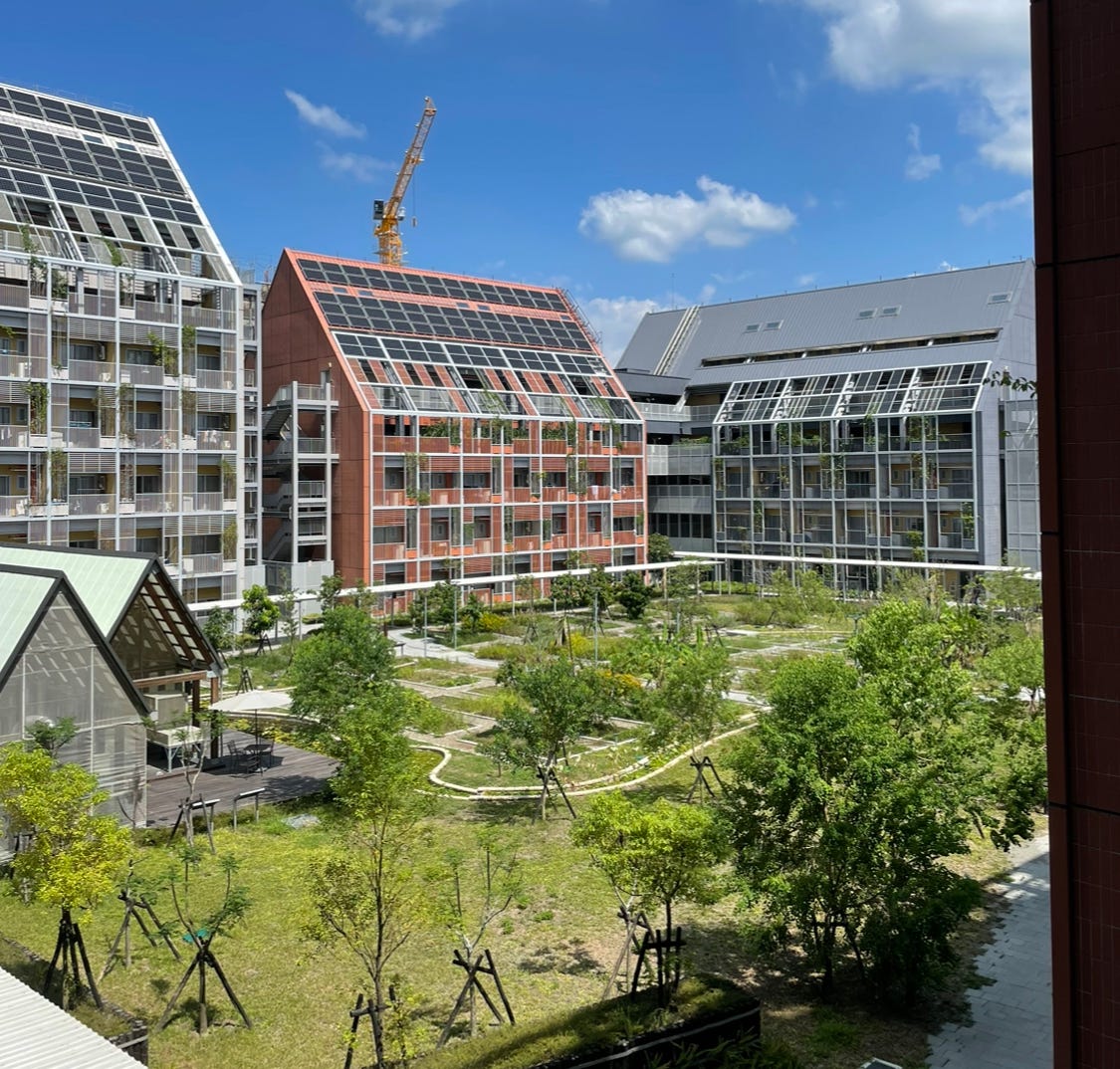
Early on it actually seemed like the Americans might really enjoy their new jobs. TSMC paid for hundreds of them to move to Taiwan for periods of about 10-14 months, during which they lived in two fully paid for apartment complexes in Tainan, a city on the south side of the island. Many of these Americans were fresh out of college, and suddenly found themselves salaried with free housing and surrounded by peers with nothing to do. As you can imagine, a lot of drinking ensued. This might sound like a bad idea, but the Americans I know mostly remember that time fondly. Some have gone so far as to say they would do it all again, if they could. All, however, have had a much worse experience in Phoenix.
There’s lots of reasons for the American’s dissatisfaction, but I want to dispel a major myth first: TSMC does not pay low wages. Based on a review of glassdoor salary ranges, and conversations with numerous American engineers, TSMC pays if anything slightly above the market rate in the US. They actually gave most of the American hires a huge (like 20%) raise while in Taiwan, after they realized they were offering uncompetitive salaries. TSMC does not have a problem paying market wages. Their problem is that, for those wages, they demand above-market effort and productivity.
Americans are not, generally, unfamiliar with long working hours. American lawyers, doctors, investment bankers, and more are famous for putting in long days and weekend shifts. The problem for TSMC is that in America the people who want to do this don’t generally go into engineering, and even if they did they would demand salaries more in line with those at big tech firms like Amazon (think, like $200,000 straight out of undergrad). Meanwhile, a TSMC engineer in Taiwan generally makes about $65,000-100,000/year (depending on bonuses) and is required to have a masters or PHD from a top university.
This point is really the one I want to drive home, because it’s the foundation of my thesis here: TSMC is used to operating in a MUCH more advantageous environment. In Taiwan TSMC is the 800lb gorilla in the room. They are a $600 Billion company in a country that only has an $800 Billion economy. That’s like if Amazon were worth $19 Trillion in the US. Depending on how you do the numbers, TSMC is around 10% of Taiwans whole economy. The entire Taiwanese government is only around 17%. This kind of size relative to a home country is basically unprecedented, and comes with a host of special privileges.
First among those privileges is political access. TSMC, being as large as it is, has a direct line to the Taiwanese government. Some have even joked that TSMC basically is the government, and they’re not as far off as you might think. Taiwanese president Tsai Ing Wen came to visit the dorms where the Americans stayed, and the founder of TSMC Morris Chang has been appointed APEC envoy for Taiwan no less than 6 times. While it’s impossible to quantify exactly how much influence TSMC has over Taiwanese policy, nobody disputes that it is substantial.
TSMC’s size also grants it major economic power, and here we get to the heart of why it finds it so difficult to operate in the US. In Taiwan, working at TSMC is an extremely prestigious job. It’s basically like working at Apple if Apple were ten times larger. Turnover is thus extremely low despite its harsh management culture, enabling TSMC to extract that much more productivity from an already talented and hardworking labor force. This power over the labor market, which economists call Monopsony, is a major advantage for TSMC’s global competitiveness (it’s also something that would never be tolerated under antitrust laws in the US or Europe, even under the most lax enforcement regime). As a result, Taiwanese management has a hard time understand how Americans just up and leave when they are mistreated. TSMC is used to having much more control over its workers.
This isn’t to say that the US hires aren’t productive, however. If you read the article at the top, you’ll note that a common complaint from American hires is actually that the company isn’t efficient enough. The Americans aren’t frustrated with having to work hard, they’re frustrated at having to work hard for no reason. I’ve talked with well over a dozen engineers at this point, all of whom say the same thing. When talking with engineers from the fab, I’ve often joked that it sounds like a good software engineer could automate half of them out of a job. The most common response? Yes, but management would never allow it. So while there are surely some gaps in skill, this isn’t a story of an incompetent American labor force. In practice, the Taiwanese management’s main issue doesn’t seem to be that the Americans can’t do the job, but more that they just don’t do the job hard enough. Taiwanese assignees make this even worse by ridiculing Americans. The assignees took to calling them “big babies” for complaining about a lack of work life balance.
And that’s just the beginning of the ways that TSMC creates a hostile work environment. As noted in the RestOfWorld article, some male employees in Taiwan had suggestive or outright explicity material on their desks, and from what I heard it was often much more than that. While in Taiwan I heard there was often straight up porn being openly displayed and passed around in Line channels. One person said their manager offered to buy them a prostitute. As I understand it, this has mostly not migrated over to the US fab, but plenty of other problems have. One engineer I talked to recounted a rumor of a Taiwanese manager literally assaulting an American manager (I can’t verify this one for sure, but I remember hearing the story at the time so I’m inclined to believe it’s true). Another engineer recalled stories of coworkers crying in the office after being berated by management for failing to meet unclear or unreasonable expectations.
That said, the cultural difference by itself might be a surmountable challenge. After all, foreign firms operate in the US all the time, including other Southeast Asian companies with harsh management cultures. Japan has had a successful automative presence in the US for decades. However, the productivity issue is really hard to resolve. Interestingly, it’s not really an issue of low pay. As I stated earlier, TSMC actually pays pretty high wages, especially by Taiwanese standards. The median Taiwanese income is low, on the order of $21,000/yr. In Taiwan TSMC will easily pay triple or quadruple that, plus annual bonuses that can double some workers total income. Factor in the cost of living, which is 50-70% lower in Taiwan in my experience, and TSMC engineers can clear the equivalent of $200,000 USD/yr. Those kind of numbers make it hard to argue that TSMC is underpaying their workers.
Yet that is exactly what I will do. Total compensation at TSMC may be high in absolute terms, but remember that what matters is pay relative to productivity. Also remember that we’re talking about possibly the hardest working, most talented, most technically competent workforce at the top company in what is quite possibly the most advanced industry on the planet. It would be wild if those workers weren’t paid boatloads of money! It is entirely possible, then, that TSMC is simultaneously paying the highest wages in its host country while still underpaying its workforce, especially if we’re comparing to the US where a General Manager at a large gas station can make $150,000.
What’s more, there’s at least some hard data to back this up. Taiwan runs an absolutely absurd trade surplus of over 10% of GDP. This basically means that Taiwanese workers make a lot more stuff than they consume. That extra money has to go somewhere, and usually I would say its in the form of savings. High savings aren’t necessarily bad, especially in developing countries where they can be used to make needed investments. However, Taiwan is already highly developed. It has a world class High Speed Rail system, great healthcare, good infrastructure, and living standards more or less in line with the developed world. It doesn’t have major investment needs, certainly not to the extent that would justify such a high trade surplus. An ironclad rule of economics is that savings has to equal investment, so it seems highly unlikely that all this extra money is being saved. But that money has to go somewhere, so where is it?
This is hard to prove, but I will argue that the most likely place this money goes is right back to TSMC. Basically, workers just don’t get paid that extra money, and TSMC gets to keep it. This would line up perfectly with the experience of the US hires: TSMC wants to get the same deal they get in Taiwan, which means keeping a lot more of what the workers produce. The Americans aren’t cool with that, because it means them working harder for the same or less money than they can get elsewhere. It would also explain TSMC’s incredible competitiveness, despite the inefficient internal culture that the Americans complain about: in effect, this gap between pay and productivity represents a massive ongoing subsidy of TSMC by Taiwanese workers.
It’s hard to say exactly how much TSMC might benefit from this, but we can do some quick numbers to make a guess. The Taiwanese people are, on average, producing about 10% more than they consume. That’s just the definition of a trade surplus. That implies that, one way or another, about $80 Billion/yr is being transferred away from consumers (workers and their families) and to businesses. If we remember that TSMC is about 10% of the whole Taiwanese economy, and assume that these transfers are evenly distributed (which, if anything, we would expect them to be distributed more to the most powerful company in the country), it’s possible that TSMC is recieving transfers of 1% of Taiwanese GDP every year. For reference, the entire CHIPS Act (not just the portion TSMC got) was a one time deal worth about 0.2% of US GDP ($52 Billion). These transfers wouldn’t show up in official trade data, because they probably take the form of implicit subsidies like tolerance of monopsony power (which allows wage suppression), education programs geared specifically for the company, currency manipulation, and political access to promote a favorable regulatory environment. If that were true, it would pretty easily explain why TSMC finds it so much harder to operate in the US. It’s just a lot easier to do business when you have a whole society working to support you.
Now, it’s all surely a lot more complicated than that. Taiwan’s low cost of living definitely helps, and the Taiwanese education system is genuinely very good at churning out talented skilled workers, and not just for TSMC. Nevertheless, the experience of the US hires heavily implies that a major part of the problem just boils down to policy. Taiwanese policy is set up to support TSMC, such that they can pay less and get more, especially from workers. American policy, meanwhile, makes manufacturing more difficult through stringent permitting, stronger (relative to Taiwan) labor rights, and a currency boosted by its role as the world’s reserve.
So for now we have an intractable problem. Unless TSMC unlocks some major efficiency in the US that can’t be transferred back to Taiwan, they will be stuck trying to force Americans to make up the gap by working ever harder. This will continue to cause conflict between the American workers and Taiwanese management. The result will be high turnover, low yields, and a fab that will operate at significantly higher costs than those in Taiwan. Resolving this will require either ongoing subsidization, customers to accept higher prices, or structural changes in the US or Taiwan that resolve the pay/productivity gap. None of these seem likely to occur right now. In the words of Morris Chang, it’s entirely possible that this ends up being an “expensive exercise in futility”. Just know that, if it does, it was a policy choice.
If you enjoyed this article, consider subscribing! I blog about trade and technology from the perspective of a software engineer and former congressional policy advisor. This blog is a hobby, so everything I write is free, no paid tiers or anything.